
Make a Decision
And then call the world around you to do the same.

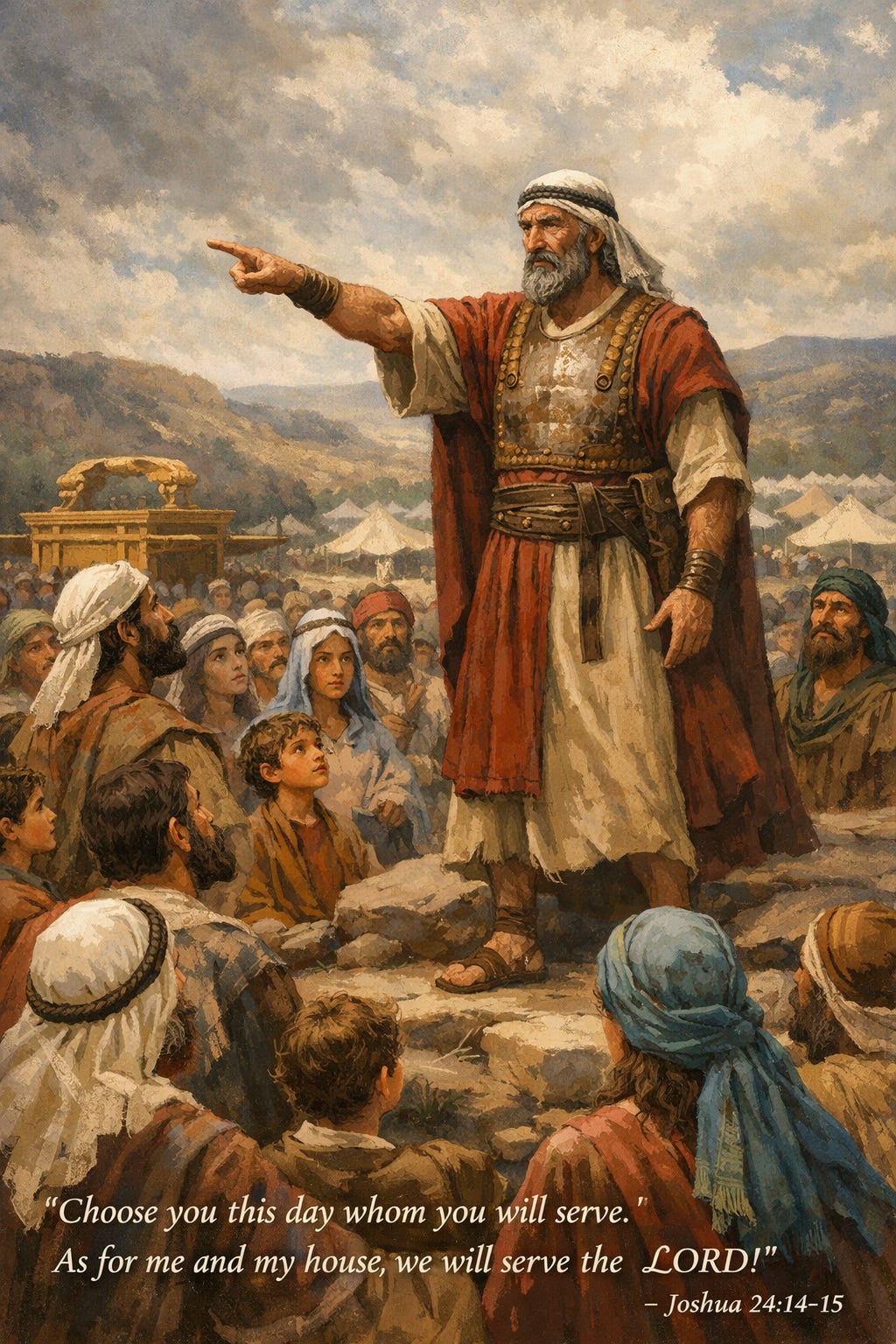
“Now therefore, fear the Lord, serve Him in sincerity and in truth, and put away the gods which your fathers served on the other side of the River and in Egypt. Serve the Lord! 15 And if it seems evil to you to serve the Lord, choose for yourselves this day whom you will serve, whether the gods which your fathers served that were on the other side of the River, or the gods of the Amorites, in whose land you dwell. But as for me and my house, we will serve the Lord” (Joshua 24:14,15).
The Israelites had finally made it to the promised land of Canaan and taken control of the land. Forty years of wandering in the wilderness, multiple years of wars to gain possession of Canaan, and the business of starting their new homes had changed the pattern of their lives.
Joshua, Caleb, high priest Eleazar, and maybe a few others were the only remaining Israelites who could easily remember the days of slavery in Egypt. Those who were mere teenagers when they had left Egypt were now in their 80s. As a nation, the majority hadn’t seen the plagues of Egypt, the Red Sea part, heard the voice of Christ from Mount Sinai, felt the ground churning as Korah, Dathan, and Abiram were swallowed in the sinkhole, or known the pain of condemnation as the nation was told they were not allowed to enter Canaan.
As the years of conquest had passed, the population that could not remember the end of the wanderings, the falling of the manna, the pillar of cloud, the last call by Moses, the fall of Jericho, and the sun standing still was quickly growing. Joshua felt the call of God to, as Moses had done before, present before Israel the choice they would face both individually and corporately as he would soon be laid to rest.
Joshua recounted before the people the call and travels of Abraham. He reviewed the promises given to Abraham, Isaac, and Jacob. Joshua then described the power of God to save His people from their enemies. From the plagues sent on the Egyptians at the hands of Moses and Aaron, to the victories over the Amorites east of the Jordan, enemies that made Goliath seem miniature in comparison.
Then Joshua turned from political enemies to spiritual enemies. While the Egyptians and Amorites ultimately worshiped Satan and did his bidding in opposing Israel, the Moabites had turned directly to sorcery in an attempt to cripple Israel. The Moabites and Ammonites were descendants of Abraham’s nephew, Lot. God had told Israel they were not allowed to destroy the descendants of Lot or Esau (the Edomites).
In appealing to Balaam, a former prophet of God, to cast a demonic spell on the Israelites, King Balak had chosen the rule of Satan over the rule of Christ. Just as Lot had physically separated himself from the presence of God’s servant Abraham and cast his tent towards Sodom, King Balak now separated completely himself from acknowledging the true God and aligned himself with Satan. But God would not allow Balaam to speak the words of Satan. Only the blessings of God issued from his lips. God openly demonstrated to both Israel and Moab that He is stronger than Satan and his agencies for evil.
Joshua then reminded Israel that God had led them across the Jordan and given them the city of Jericho. Following the initial victory, seven nations were given into the hands of Israel, not through human power, but through the workings of Divine Providence. Israel had been given control of cities they hadn’t built and farms they hadn’t plowed or planted.
As you read the entire narrative in Joshua 24, you notice that Joshua begins by saying, “Thus says the Lord God of Israel” (Joshua 24:2). The entire history is presented in the first person as the voice of God. It was essentially an expansion of Christ’s preamble to the Ten Commandments.
And God spoke all these words, saying: 2 “I am the Lord your God, who brought you out of the land of Egypt, out of the house of bondage (Exodus 20:1,2).
God was speaking through the voice of Joshua to tell the Israelites why He alone was their Source of victory and protection, just as He had spoken through the voice of Moses.
Turning from the Divine history, Joshua issued a call to all of Israel. A call to return to God the devotion and worship that He alone is worthy of.
Now therefore, fear the Lord, serve Him in sincerity and in truth, and put away the gods which your fathers served on the other side of the River and in Egypt. Serve the Lord! (Joshua 24:14).
Joshua then turned from a call to repentance to a call for a firm and constant decision. Joshua did not appeal to emotion. Joshua appealed to reason.
And if it seems evil to you to serve the Lord, choose for yourselves this day whom you will serve, whether the gods which your fathers served that were on the other side of the River, or the gods of the Amorites, in whose land you dwell. But as for me and my house, we will serve the Lord (Joshua 24:15).
In no uncertain terms, Joshua delineated the futility of worshiping false gods. In just two verses he mentioned false gods from three geographical locations, all of which ultimately were as demonic in origin as the sorcery of Moab. The gods of Terah’s household, from which Abraham was called out, the gods of Egypt, which couldn’t stop a single plague, and the gods of the Amorites, who could not stop the conquest of their land by God’s people. All these were listed as examples of gods vastly inferior to the God that stooped to claim Israel as His chosen people. Why would any reasonable, thinking Israelite ever follow the gods who couldn’t protect the people who worshiped them?
Isaiah used the same logic to describe the foolishness of idolatry.
Those who make an image, all of them are useless,
And their precious things shall not profit;
They are their own witnesses;
They neither see nor know, that they may be ashamed.
10 Who would form a god or mold an image
That profits him nothing?
11 Surely all his companions would be ashamed;
And the workmen, they are mere men.
Let them all be gathered together,
Let them stand up;
Yet they shall fear,
They shall be ashamed together.
12 The blacksmith with the tongs works one in the coals,
Fashions it with hammers,
And works it with the strength of his arms.
Even so, he is hungry, and his strength fails;
He drinks no water and is faint.
13 The craftsman stretches out his rule,
He marks one out with chalk;
He fashions it with a plane,
He marks it out with the compass,
And makes it like the figure of a man,
According to the beauty of a man, that it may remain in the house.
14 He cuts down cedars for himself,
And takes the cypress and the oak;
He secures it for himself among the trees of the forest.
He plants a pine, and the rain nourishes it.
15 Then it shall be for a man to burn,
For he will take some of it and warm himself;
Yes, he kindles it and bakes bread;
Indeed he makes a god and worships it;
He makes it a carved image, and falls down to it.
16 He burns half of it in the fire;
With this half he eats meat;
He roasts a roast, and is satisfied.
He even warms himself and says,
“Ah! I am warm,
I have seen the fire.”
17 And the rest of it he makes into a god,
His carved image.
He falls down before it and worships it,
Prays to it and says,
“Deliver me, for you are my god!”
18 They do not know nor understand;
For He has shut their eyes, so that they cannot see,
And their hearts, so that they cannot understand.
19 And no one considers in his heart,
Nor is there knowledge nor understanding to say,
“I have burned half of it in the fire,
Yes, I have also baked bread on its coals;
I have roasted meat and eaten it;
And shall I make the rest of it an abomination?
Shall I fall down before a block of wood?”
20 He feeds on ashes;
A deceived heart has turned him aside;
And he cannot deliver his soul,
Nor say, “Is there not a lie in my right hand?” (Isaiah 44:9-20).
How easy is it to sit back and ponder how stupid the Israelites were for choosing to worship idols from the golden calf at Mount Sinai through the fall of Jerusalem to the Babylonians? Why would they place their trust in false gods inferior to themselves when the King of heaven was ready and waiting to meet their every need?
The Jews of Jesus’ day had similar thoughts of spiritual superiority to their ancestors. Yet Jesus said to them:
“Woe to you, scribes and Pharisees, hypocrites! Because you build the tombs of the prophets and adorn the monuments of the righteous, 30 and say, ‘If we had lived in the days of our fathers, we would not have been partakers with them in the blood of the prophets.’
31 “Therefore you are witnesses against yourselves that you are sons of those who murdered the prophets. 32 Fill up, then, the measure of your fathers’ guilt (Matthew 23:29-32).
Is it possible that Jesus’ rebuke to the religious elites of His day would even more appropriately be delivered to those who claim the name “Christian” today? It is easy for us to sit back and assume that we would have responded to Joshua as Israel did that day:
“Far be it from us that we should forsake the Lord to serve other gods; 17 for the Lord our God is He who brought us and our fathers up out of the land of Egypt, from the house of bondage, who did those great signs in our sight, and preserved us in all the way that we went and among all the people through whom we passed. 18 And the Lord drove out from before us all the people, including the Amorites who dwelt in the land. We also will serve the Lord, for He is our God” (Joshua 24:16-18).
Except, of course, we are certain that we would actually come through on our promises to God, unlike Israel. Of course we would! Or so we assume.
Think for a moment what the purpose for Israel was. Yes, Joshua was calling them to personally and corporately come to a decision for Christ. But by making the decision, they were also commissioned to extend that call to all within their sphere of influence. God handed Israel the geographic crossroads of the world. All traffic to and from Egypt to Mesopotamia, as well as to what is now Turkey or Europe had to pass through Israel. If the shipping was done by sea, the seafarers of Tyre and Phoenicia were right next to Israel, and God’s message of salvation could be easily extended to these ports of trade.
But instead of giving the message of salvation through the Promised Lamb of God to the known world, hundreds of years later we find another prophet giving Israel the very same call to a decision that Joshua gave. They had fallen all the way back to almost complete idolatry.
And Elijah came to all the people, and said, “How long will you falter between two opinions? If the Lord is God, follow Him; but if Baal, follow him.” But the people answered him not a word (1 Kings 18:21).
The God who delivered you from bondage to Egypt and offers deliverance from sin? Or the false gods who couldn’t make it rain for the past three and a half years? Who will you choose to worship? Quit trying to ride the fence.
Instead of the response assuring faithfulness that Joshua received, Elijah was met with silence. It was only after fire from heaven devoured the sacrifice and left a crater that the people were willing to acknowledge the supremacy of the true God.
Then the fire of the Lord fell and consumed the burnt sacrifice, and the wood and the stones and the dust, and it licked up the water that was in the trench. 39 Now when all the people saw it, they fell on their faces; and they said, “The Lord, He is God! The Lord, He is God!” (1 Kings 18:38,39).
Yet again, they broke their promise, they returned to idolatry and the nation of Israel was taken into captivity. Of the land of Judah the mournful history reads:
And the Lord God of their fathers sent warnings to them by His messengers, rising up early and sending them, because He had compassion on His people and on His dwelling place. 16 But they mocked the messengers of God, despised His words, and scoffed at His prophets, until the wrath of the Lord arose against His people, till there was no remedy (2 Chronicles 36:15,16).
As we begin 2026, it is good time to remember that Jesus is still issuing the call to you and me.
Behold, I stand at the door and knock. If anyone hears My voice and opens the door, I will come in to him and dine with him, and he with Me. 21 To him who overcomes I will grant to sit with Me on My throne, as I also overcame and sat down with My Father on His throne (Revelation 3:20,21).
It’s the same call. The choice is between trusting the empty promises of false gods, mocking the messengers of God and scoffing at His Words, leading to certain and eternal death, versus the assurance of sitting with Christ in heavenly places simply by believing His promises are true and claiming them personally, allowing Him to apply them to our lives.
But just as Israel was supposed to call the entire world to a decision for Christ, each and every follower of Christ is commissioned to share the same call within whatever sphere of influence God has provided or will provide for us.
And Jesus came and spoke to them, saying, “All authority has been given to Me in heaven and on earth. 19 Go therefore and make disciples of all the nations, baptizing them in the name of the Father and of the Son and of the Holy Spirit,20 teaching them to observe all things that I have commanded you; and lo, I am with you always, even to the end of the age” (Matthew 28:18-20).
If through the deliverance He has already provided, you determine to accept His call to full discipleship, then your world is your mission field. Maybe you have a bully pulpit and can reach millions. Pray that you use your pedestal wisely for His kingdom. Maybe you are physically unable to move and you have no one but your caregiver to share Christ with. If they don’t know Christ, offer them His salvation. If they know Christ, strengthen and encourage them in their walk with Him and their work to reach others.
We each need to hear the call of God through Joshua’s message at Shechem. But if and when we accept that call, we need to realize we have another role. Today, if you are Christ’s, you are Joshua at Shechem. You are Noah just before the door of the ark closed. You are Elijah on Mount Carmel. You are Peter on the Day of Pentecost. You are Luther before the Diet of Worms.
Like Joshua, you are not called to speak your own words. “Thus saith the Lord,” is your message to a dying world. The Bible’s presentation of salvation is the message. The Word is God’s. We are simply called to be the mouthpiece, the conduit of that Word.
We will resume our study of Daniel in the coming presentations. Daniel, like the rest of the Bible, is a call to worship Christ and Him alone. To abandon the false promises from spiritual Babylon and cling to Christ.
Standing firm, trusting the promised deliverance of God when the world demands the death of God’s people will seem like a stupid choice to the short-sighted. Yet in the eyes of heaven, it is the only logical choice available. God can and will protect His people from the threats of man. No man can protect themselves or others from the awful results of disobedience as presented in the Word of God. The wages of sin IS death (Romans 6:23).
The Book of Daniel is also a call to share what God has revealed to everyone who will listen. Most will reject the offer of mercy, but all need to receive it. Those who see what is truly valuable, those who see through Heaven’s eyes, will make a stand for Christ that will proclaim His glory throughout eternity.
Those who are wise shall shine
Like the brightness of the firmament,
And those who turn many to righteousness
Like the stars forever and ever (Daniel 12:3).
In these final days of earth’s history, be wise in God’s eyes.
The fear of the Lord is the beginning of knowledge,
But fools despise wisdom and instruction (Proverbs 1:7).
Answer God’s call to worship Him alone. Not in your own strength, but entirely in His.
I call heaven and earth as witnesses today against you, that I have set before you life and death, blessing and cursing; therefore choose life, that both you and your descendants may live (Deuteronomy 30:19).
Then extend that invitation to the entire world.
Then I saw another angel flying in the midst of heaven, having the everlasting gospel to preach to those who dwell on the earth—to every nation, tribe, tongue, and people— 7 saying with a loud voice, “Fear God and give glory to Him, for the hour of His judgment has come; and worship Him who made heaven and earth, the sea and springs of water” (Revelation 14:6,7).
May you and your family have a blessed 2026!
He who testifies to these things says, “Surely I am coming quickly.”
Amen. Even so, come, Lord Jesus! (Revelation 22:20).