
The Final Vision Begins
Daniel: A Call to Worship--Part 33

Now I tell you before it comes, that when it does come to pass, you may believe that I am He (John 13:19).
Jesus told His disciples that one significant aspect of prophecy was to establish our faith in His Word after we have seen the fulfillment of said prophecy. When we see His Word come true as predicted, we can have faith that the rest of what He said is also true, whether or not we can “test” or see the fulfillment of the prophecy in our lifetime or with our human eyes.
There are prophecies that make no sense to us at all until we see the fulfillment. The prophecies pointing to Judas and the betrayal money were absolutely correct, but reading them in advance of the event would have seemed weird at best and likely preposterous.
Arise and go down to the potter’s house, and there I will cause you to hear My words (Jeremiah 18:2).
Then I said to them, “If it is agreeable to you, give me my wages; and if not, refrain.” So they weighed out for my wages thirty pieces of silver.
13 And the Lord said to me, “Throw it to the potter”—that princely price they set on me. So I took the thirty pieces of silver and threw them into the house of the Lord for the potter (Zechariah 11:12,13).
Why would anyone throw thirty pieces of silver into the temple for a potter? It makes no sense. Yet it was exactly fulfilled.
Then Judas, His betrayer, seeing that He had been condemned, was remorseful and brought back the thirty pieces of silver to the chief priests and elders, 4 saying, “I have sinned by betraying innocent blood.”
And they said, “What is that to us? You see to it!”
5 Then he threw down the pieces of silver in the temple and departed, and went and hanged himself.
6 But the chief priests took the silver pieces and said, “It is not lawful to put them into the treasury, because they are the price of blood.” 7 And they consulted together and bought with them the potter’s field, to bury strangers in. 8 Therefore that field has been called the Field of Blood to this day (Matthew 27:3-8).
In some ways, the prophetic narrative presented in Daniel 11 and 12 is the most complete historical narrative in the book of Daniel. In other areas, it can initially seem confusing or even preposterous. But we can trust the words of Jesus. Parts of it may seem to line up with multiple views of accurate history. Parts of it may not be fulfilled yet. Parts of it may have been fulfilled but we haven’t figured out where yet. But we can trust that it is true and that when we understand it as Christ wants us to, our faith will be strengthened.
Critics of the Bible, often skeptics who do not want to accept the reality of a God who transcends time and knows the future, have tried to create doubt regarding the prophetic narrative of Daniel 11 and 12. Some have insisted that it is so precise it had to have been written at least several hundred years after Daniel died. Others have tried, as with Daniel 8, to apply the prophecy to Antiochus Epiphanes, relegating the prophecy to the ancient past.
Yet the Bible clearly demonstrates a prophetic accuracy far beyond the lifespan of Antiochus Epiphanes. We have seen a clear pattern of this in the book of Daniel. Chapter 2 had four kingdoms and then the return of Christ, ending the world as we know it. Everything in chapter 2, save the as yet unfulfilled return of Christ has proven true over the past 2600 years of earth’s history. Chapters 7 and 8 had the same sequence of kingdoms while also presenting the power many Christians call “the antichrist” as well as introducing a heavenly judgment scene that precedes the return of Christ.
Three prophetic narratives. Some more expansive than the others, some may have been written late enough to skip Babylon and begin with Medo-Persia, some may be more detailed about some aspects than others. But altogether, the narratives are consistent and repetitive. Some Bible scholars call this the principle of “repeat and enlarge.”
It would not be true to our study of Daniel to approach the prophetic narrative of Daniel 11 and 12 in any other light than what God has revealed in the first three great prophetic narratives in the book. Unless God reveals otherwise in His Word, we should begin with the understanding that the narrative of Daniel 11 and 12 will progress through these same kingdoms, beginning with the time of Daniel, traversing the scope of history through pagan Rome, papal Rome, the Heavenly judgment and finally the return of Christ.
Babylon had already fallen by the time Daniel was given this final vision. Thus, the vision begins with the reign of Medo-Persia.
Also in the first year of Darius the Mede, I, even I, stood up to confirm and strengthen him. 2 And now I will tell you the truth: Behold, three more kings will arise in Persia, and the fourth shall be far richer than them all; by his strength, through his riches, he shall stir up all against the realm of Greece (Daniel 11:1,2).
Gabriel was telling Daniel what had happened as well as what would happen. Note that the vision was given to Daniel after Cyrus had been reigning for several years.
In the third year of Cyrus king of Persia a message was revealed to Daniel, whose name was called Belteshazzar. The message was true, but the appointed time was long; and he understood the message, and had understanding of the vision (Daniel 10:1).
Gabriel told Daniel that Medo-Persia would continue to get stronger and richer through three powerful kings, and then a fourth would exceed them all. Xerxes, this fourth king, would begin the wars against Greece that would continue intermittently for over a century.
Then a mighty king shall arise, who shall rule with great dominion, and do according to his will. 4 And when he has arisen, his kingdom shall be broken up and divided toward the four winds of heaven, but not among his posterity nor according to his dominion with which he ruled; for his kingdom shall be uprooted, even for others besides these (Daniel 11:3,4).
Gabriel told Daniel that the Greek ruler who would overcome Medo-Persia would die without an heir and his kingdom would be divided across the four winds of heaven, the four points of the compass. The wording of this passage had to take Daniel’s mind back immediately to the prophecies of the previous narratives, especially from Daniel 8.
then another, a third kingdom of bronze, which shall rule over all the earth (Daniel 2:39).
After this I looked, and there was another, like a leopard, which had on its back four wings of a bird. The beast also had four heads, and dominion was given to it (Daniel 7:6).
And as I was considering, suddenly a male goat came from the west, across the surface of the whole earth, without touching the ground; and the goat had a notable horn between his eyes. 6 Then he came to the ram that had two horns, which I had seen standing beside the river, and ran at him with furious power. 7 And I saw him confronting the ram; he was moved with rage against him, attacked the ram, and broke his two horns. There was no power in the ram to withstand him, but he cast him down to the ground and trampled him; and there was no one that could deliver the ram from his hand.
8 Therefore the male goat grew very great; but when he became strong, the large horn was broken, and in place of it four notable ones came up toward the four winds of heaven (Daniel 8:5-8).
The ram which you saw, having the two horns—they are the kings of Media and Persia. 21 And the male goat is the kingdom of Greece. The large horn that is between its eyes is the first king (Daniel 8:20,21).
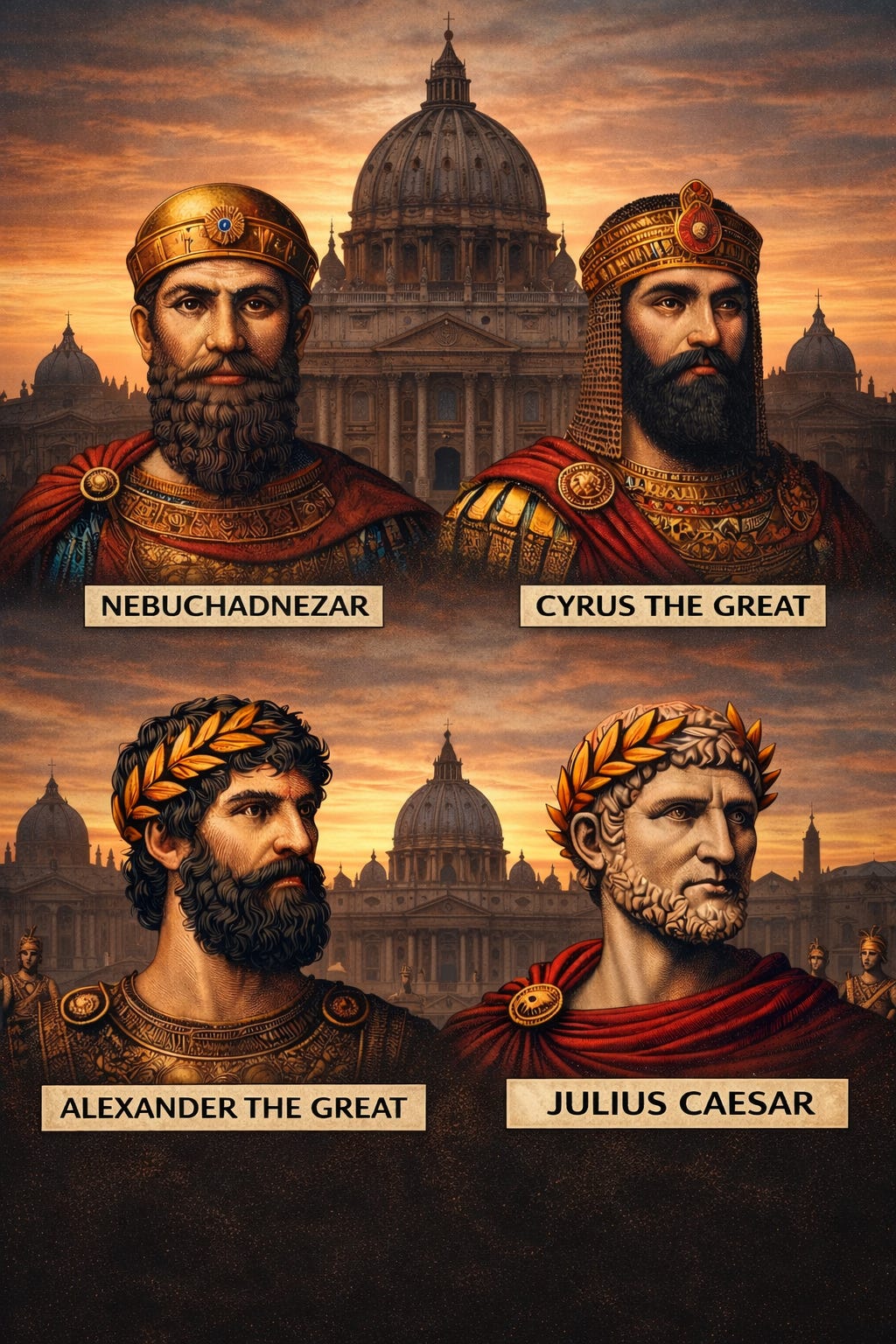
As in Daniel 8, the passage in Daniel 11 is specifically prophesying the conquests and untimely death of Alexander the Great. He had no heirs to the throne, and his kingdom was divided between four Greek generals: Ptolemy, Cassander, Lysimachus, Seleucus.
The prophecy wording then shifts from specifically naming kingdoms, such as Medo-Persia and Greece, to referring to different kingdoms by direction, namely the kings of the north and the south. This has multiple implications in interpreting the prophecies that follow. And in fairness, a lot of the confusion of studying Daniel 11 comes from these seemingly vague references that replace the specific names of various kingdoms.
In the earliest and most literal sense of the prophecy, the Greek divisions were directed to the four points of the compass. Cassander had the furthest west territory, comprised mainly of what we consider Greece today. Ptolemy ruled over Egypt as the southern division. Seleucus was technically the kingdom furthest east, but by later defeating Lysimachus, Seleucus was then entrenched as king of both the east and north.
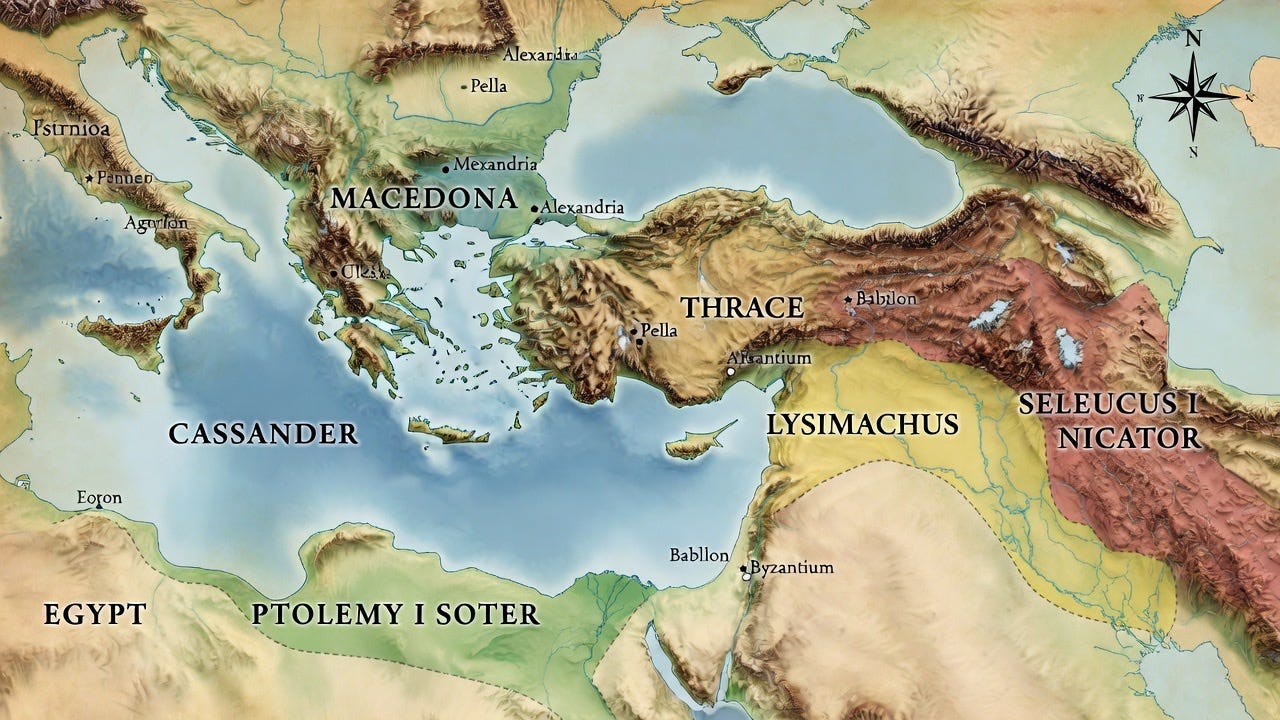
In a broader sense, the kingdoms were named for the direction from which they would come and pose a threat to Jerusalem. History tells of a great naval conflict between Medo-Persia and Greece. It tells of the mariner skill and exploits of the Phoenicians. Yet Israel was almost always attacked by land rather than sea. The great trade routes would bring armies from the north or south, but Israel was relatively safe from attacks via the Mediterranean to the west or the Arabian desert to the east.
While warning God’s people of the impending invasion from Babylon, Jeremiah referred to Babylon both as the kingdom from the north and a lion. Remembering the winged lion from Daniel 7:4 and studying the king of the north in Daniel 11, both notations are prophetically significant.
Set up the standard toward Zion.
Take refuge! Do not delay!
For I will bring disaster from the north,
And great destruction.”
7 The lion has come up from his thicket,
And the destroyer of nations is on his way.
He has gone forth from his place
To make your land desolate.
Your cities will be laid waste,
Without inhabitant (Jeremiah 4:6,7).
The obvious question is, why would Babylon be called the king of the north when it is located far more east than north of Jerusalem? The sentinels on the walls of Jerusalem didn’t have great maps of what we now call the Middle East. What they knew was that if Babylon was going to attack Jerusalem, they would be coming through Syria via the roads from the north.
With that understanding, Gabriel presented Daniel with an absolutely amazing historical narrative. The Seleucid kingdom in Syria (the north) and the Ptolemeic kingdom in Egypt (the south) battled for supremacy until the Seleucid kingdom was overcome by Rome. Rome then, as the northern kingdom, continued to battle the Ptolemeic kingdom until Julius Caesar defeated Egypt and the Roman Empire encircled the Mediterranean Sea.
Also the king of the South shall become strong, as well as one of his princes; and he shall gain power over him and have dominion. His dominion shall be a great dominion. 6 And at the end of some years they shall join forces, for the daughter of the king of the South shall go to the king of the North to make an agreement; but she shall not retain the power of her authority, and neither he nor his authority shall stand; but she shall be given up, with those who brought her, and with him who begot her, and with him who strengthened her in those times. 7 But from a branch of her roots one shall arise in his place, who shall come with an army, enter the fortress of the king of the North, and deal with them and prevail. 8 And he shall also carry their gods captive to Egypt, with their [c]princes and their precious articles of silver and gold; and he shall continue more years than the king of the North.
9 “Also the king of the North shall come to the kingdom of the king of the South, but shall return to his own land. 10 However his sons shall stir up strife, and assemble a multitude of great forces; and one shall certainly come and overwhelm and pass through; then he shall return to his fortress and stir up strife.
11 “And the king of the South shall be moved with rage, and go out and fight with him, with the king of the North, who shall muster a great multitude; but the multitude shall be given into the hand of his enemy. 12 When he has taken away the multitude, his heart will be lifted up; and he will cast down tens of thousands, but he will not prevail. 13 For the king of the North will return and muster a multitude greater than the former, and shall certainly come at the end of some years with a great army and much equipment.
14 “Now in those times many shall rise up against the king of the South. Also, violent men of your people shall exalt themselves in fulfillment of the vision, but they shall fall. 15 So the king of the North shall come and build a siege mound, and take a fortified city; and the forces of the South shall not withstand him.Even his choice troops shall have no strength to resist. 16 But he who comes against him shall do according to his own will, and no one shall stand against him. He shall stand in the Glorious Land with destruction in his power (Daniel 11:5-16).
An important thought here for our day. As the kings from the north and south kept fighting each other, Jerusalem and the land of Israel were repeatedly overrun by marauding armies of both the north and south pillaging whatever they wanted as they passed through.
It would have been easy for the Jews to seek protection by picking a side and submitting to the rule of that power. But it was important for the Jews to remember that both the kingdoms of the north and the south were kingdoms of man set up in rebellious opposition to the King of Heaven.
Our nation and our world today are extremely divided in so many ways. It often feels like God’s people should attach ourselves to a political party that we believe will most closely align with the goals that we are Christians strive to achieve. We can never forget that our Help is not in human government. All human political persuasions are ultimately representing kingdoms of man in rebellious opposition to the King of Heaven. We are not called to convert the world by civil control. We are called to take God’s Word to the entire planet and allow Him to change hearts.
Daniel 11 did not just prophesy the war between Rome and Egypt. The romantic twist of Antony, Cleopatra and Julius Caesar and even the assassination of Julius Caesar and its location were prophesied in Daniel 11 hundreds of years before any of the players were born.
He shall also set his face to enter with the strength of his whole kingdom, and upright ones with him; thus shall he do. And he shall give him the daughter of women to destroy it; but she shall not stand with him, or be for him. 18 After this he shall turn his face to the coastlands, and shall take many. But a ruler shall bring the reproach against them to an end; and with the reproach removed, he shall turn back on him. 19 Then he shall turn his face toward the fortress of his own land; but he shall stumble and fall, and not be found (Daniel 11:17-19).
If that sounds too general to be sure it’s about Julius Caesar, we only need to keep reading. The next passage is unmistakably prophesying the reigns of Augustus and Tiberius who succeeded Julius Caesar.
There shall arise in his place one who imposes taxes on the glorious kingdom; but within a few days he shall be destroyed, but not in anger or in battle. 21 And in his place shall arise a vile person, to whom they will not give the honor of royalty; but he shall come in peaceably, and seize the kingdom by intrigue. 22 With the force of a flood they shall be swept away from before him and be broken, and also the prince of the covenant (Daniel 11:20-22).
Caesar Augustus was the Roman Emperor who Luke revealed taxed the world just before the birth of Jesus.
And it came to pass in those days, that there went out a decree from Caesar Augustus that all the world should be taxed (Luke 2:1 KJV).
Tiberius was co-emperor with Augustus for about a year until Augustus died. Although Pilate signed the death warrant for Jesus, ultimately Tiberius was the Roman Emperor by whose authority Jesus, the Prince of the New Covenant, was crucified.
Know therefore and understand,
That from the going forth of the command
To restore and build Jerusalem
Until Messiah the Prince,
There shall be seven weeks and sixty-two weeks (Daniel 9:25).
At that time Michael shall stand up,
The great prince who stands watch over the sons of your people (Daniel 12:1).
Salvation history hinges on the cross and the resurrection. Christ’s victory over sin, Satan, and death itself was assured during those three days. The New Covenant was “confirmed.” And the fact that Daniel predicted the exact sequence of Roman emperors leading up to the Savior’s crucifixion over five centuries before Jesus was born is astounding.
It should be easy to see why Bible skeptics do not like this chapter and try to discredit it by suggesting it was written as a history instead of a prophecy. As with so many Biblical prophetic passages that have already been fulfilled, a skeptic must either admit that God knows the future or attempt to discredit God’s Word.
Arriving at the cross, we will pause the study for this presentation. We will continue studying the Daniel 11 and 12 narrative over a number of studies to come. I hope and pray that, as we study this chapter as with the entirety of Daniel, and as we see the prophecies fulfilled, we may believe.
https://www.youtube.com/live/PKHyyWRSRbg?si=aB9ubpROTuUGOmZ-&t=103
As an eyewitness to these unfolding mysteries here in the Land, I see the ancient ink of Daniel 11 transforming into our modern reality. Just as the "Prince of the Covenant" stood firm against the kingdoms of man, we now stand as a living Remnant watching the Sovereign Hand of God finalize His Restoration. This vision is not mere history; it is the Kingdom blueprint for the victory arriving at our very gates.